
Click here to view as a pdf: Introducing Our Newly Formulated 38% Swift Start® Calf Pellet
 By Carley Ciolkosz, B.S.
Livestock Nutritionist
Recently, the National Academies of Science, Engineering and Medicine (NASEM) released their newest research regarding calf nutritional requirements. These updated nutrient requirements are the result of years of research and provide the most up to date guidelines on feeding calves. Therefore, Crystal Creek® has recently updated our Swift Start® Calf Pellet formula to meet the newest NASEM guidelines, as well as add some additional benefits to the product. Our reformulation project focused on three main areas of the pellet: minerals and vitamin levels, the protein profile, and the fiber digestibility profile.
Why do the nutrient requirements in calves and cows change over time? Today, animals grow and perform better than they did 20 years ago, and with that growth and performance comes a higher nutrient demand. New research has also advanced our understanding of how nutrients are digested and absorbed. Recently we’ve learned that some nutrients absorb better than we previously thought, while others absorb more poorly. Combining all this new knowledge leads to the updated nutritional recommendations put forth by NASEM.
What is NASEM and How Often Do They Publish Guidelines?
NASEM is a government sponsored research academy that uses American universities to research the nutritional requirements of all major livestock species. Previously, the organization was known as the Nutrient Research Council or the NRC; however they changed their name to NASEM in 2015. NASEM typically release new nutritional guidelines for different species of livestock every 15-20 years. These nutritional requirements are considered the ultimate authority on livestock nutrition and guide most ration formulation and livestock feeding decisions.
Pellet Reformulation Focus Point #1: Updating Macro-Mineral, Trace Mineral and Vitamin levels
Macro minerals are essential minerals required by the body in large quantities as they aid in many essential bodily functions. These are also known as major minerals. Some macro mineral requirements in calves have recently changed. For example calcium, phosphorous, and magnesium requirements have increased in the latest NASEM publication. Therefore, we have to adjust the amounts of the macro minerals fed to ensure that the animals are receiving the correct amount needed to grow and thrive.
Trace minerals, also known as micro minerals, are needed in smaller quantities than macro minerals but are still essential for overall health. Despite the difference in required amounts, both are critical for the body to function properly. The trace mineral requirements that have also changed with recent NASEM research and have been increased in our formula include copper, iron, manganese, selenium, and zinc. Along with adjusting the amounts of macro and trace minerals included in our Swift Start® 38% Calf Pellets, we also included maximum amounts of essential vitamins such as A, D and E.
Pellet Reformulation Focus Point #2: Updating the Protein Profile
The next area that we focused on while reformulating the Swift Start® Calf Pellet was the protein profile of the pellet. The protein content in the pellet was increased from 32% to 38%. Crystal Creek® uses exclusively high quality soy proteins in our products, and we do not use any cheaper or poor quality protein sources, such as distillers. An added bonus to the protein profile is that the Swift Start® Pellet is formulated with soybean expeller meal. The expelling process “expels” the fat out of the bean, leaving just the crushed soybean. This makes it a higher protein, lower fat protein compared to other soy protein variations. This also helps the protein in the pellet be balanced for both rumen degradable protein (RDP) and bypass protein (RUP). Proper levels of RDP help feed the rumen microbes, which is important in calves that are rapidly developing their rumen and establishing their very diverse rumen flora. Having bypass protein, or RUP, allows some of the protein to bypass the rumen and get absorbed directly in the calf’s small intestine. Proper levels of bypass protein are important in promoting lean muscle growth in rapidly growing calves.
One benefit of the new, higher protein content in the pellet is that the inclusion rate of the pellet into a calf grain is now lower. Essentially, we have more protein and nutrients packed into the new pellet, so it is providing a more economical feeding approach. The new pellet is formulated for a 600lb inclusion rate for an 18% calf starter and a 500lb inclusion for a 16% calf grower. See Figure 1 for an example grain mix using the newly formulated Swift Start® Calf Pellet.
Calf Pellet Carley Ciolkosz 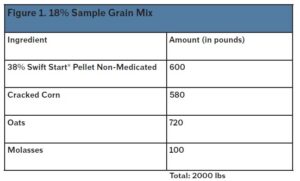
Pellet Reformulation Focus Point #3: Updating the Fiber Profile
Another area of focus during the reformulation of the Swift Start® Calf Pellets was to include the highest possible amount of digestible fiber within the pellet. Calves derive energy from both starch and digestible fiber. In fact, one pound of digestible fiber delivers the same amount of calories as a pound of starch. And when calves digest fiber, it delivers energy without the risk of acidosis, which can be caused by excessive starch digestion. The goal of our calf feeds is to have a low to moderate starch level, while maximizing the energy from digestible fiber. We applied this same approach to fiber while formulating the new Swift Start® pellet. Having higher levels of digestible fiber in the calf pellet helps support a healthier and more feed efficient calf feed program.
The new 38% Swift Start® Calf Pellets have multiple options for your convenience including Organic, Conventional Medicated and Conventional Non-Medicated formulations. If you have any questions about how the Swift Start® Calf Pellets can be used in your calf feed program, feel free to contact Crystal Creek® at 888-376-6777 to talk to one of our nutritionists about our calf program and how it can benefit your youngstock.