
Click here to view as a pdf: The Science Behind Wound Healing And The Topical Product Developed To Promote Healing: Prism™
 By Ryan Leiterman, D.V.M.
Wound healing is an important and complex process in which the body heals itself. It involves various parts of the immune system and is fascinating to learn about. This article will discuss the four stages of wound healing as well as a product, Prism™, that can be used to help the wound healing process.
The skin is one of the body’s most important defense mechanisms against infection. It provides a physical barrier that is teaming with immune cells and provides the first line of defense against invading pathogens. When this barrier is broken by a wound, the body responds by initiating a cascade of processes to heal the wound. Regardless of the size, all wounds will undergo the same four steps of healing. Those steps are:
Initial Wound Closure
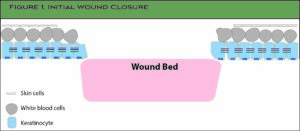
This is a fancy term for the development of the scab. The scab is made up of dried blood,
proteins and clotting agents. It serves to stop the bleeding and provide an immediate closure to the open wound. It covers and physically protects the wound bed. It is the first step of wound healing and while it may not seem as cool or dynamic as the other steps, it is arguably the most important part of the process. See Figure 1.
Keratinocyte and White Blood Cell Migration and Proliferation
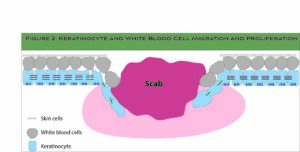
A keratinocyte is type of skin cell that acts like a first responder during any injury. These first responders break off the edges of the healthy skin tissue surrounding the wound and begin their migration down into the wound bed. They march in from all sides of the wound, working between the wound bed and the newly formed scab to slide into place and eventually line the wound bed.
At the same time, white blood cells are migrating up from the blood stream into the wound bed to help fight any infection that may have been trapped beneath the scab. A wound cannot heal while it is infected. Until the bacteria and other pathogens that are in a wound are neutralized, the wound healing process will stall at this step. Uncontrolled infection is one of the most common reasons for delayed wound healing. See Figure 2.
Contracture
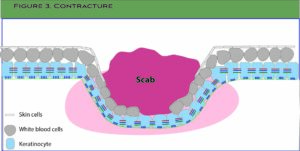
Have you ever had a cut on your hand and noticed that at some point in the healing process, the wound edges seem to be pulling themselves together? This is because the wound is undergoing the process of contracture, or closing. A specialized cell called a myofibroblast is responsible for this unique phenomena. You can think of these cells like a rope with a large spring in the middle. The cells stretch out and anchor on both sides of the wound and then the large “spring” in the middle provides a constant tension, slowly drawing the edges of the wound together. The contracture provided by these myofibroblasts have been shown to help reduce wound sizes by up to 60%. Imagine a large, intertwined web, like a spiders web, of these cells throughout the wound bed, each pulling towards the center, to close the wound. See Figure 3.
Differentiation and barrier reestablishment
The last step of the wound healing process is differentiation and barrier reestablishment.
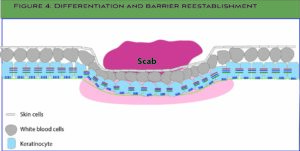
The keratinocytes from step #2 will eventually completely cover the wound bed underneath the scab. As this happens, they will secrete a chemical that will act as a signal for them to transform into epidermal (skin) cells. These skin cells transform underneath the scab at which point the scab will detach, revealing the newly formed skin beneath. See Figure 4.
What is Prism™ and how can it help wound healing?
Prism™ is a liquid topical product that is composed of different essential oils and botanicals that have been shown to have both antimicrobial, anti-inflammatory and wound healing properties. It comes in a 16 oz squeeze bottle with a convenient applicator lid to make it easy to lavage or wash a wound with the product.
Multiple research trials have shown positive effects on wound healing such as: faster healing rates, increased collagen expression at the wound site and enhanced activity of proteins involved in the tissue remodeling process when treating wounds with essential oils. The antimicrobial, anti-fungal and anti-inflammatory effects of many of the essential oils is also well documented and they have been shown effective against many of the common wound pathogens. Helping to control infection of the wound bed will help speed wound recovery time and aid in the healing process by lessening the work the body’s white blood cells need to do to fight infection.
In conclusion, the body has developed a very sophisticated process in which it heals open wounds. Despite the body’s ability to heal itself, you can help the process by using a product like Prism™, that has ingredients that have been shown to help fight infection and promote the re-epithelization process. Feel free to reach out to a Crystal Creek® livestock specialist to learn more.